 Facts Checked

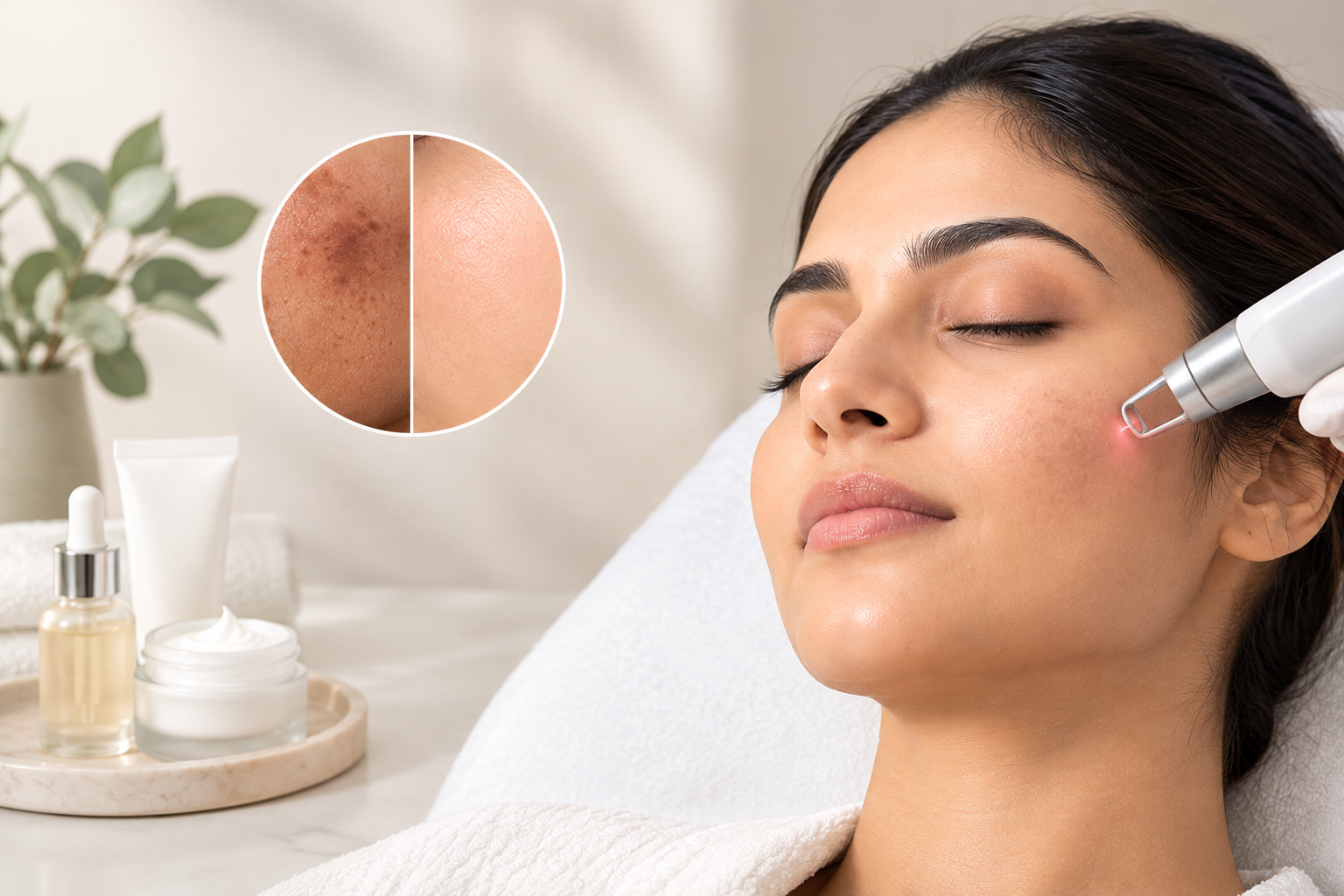
Explore a safe skin brightening routine for Indian skin, including hydration, sunscreen, pigmentation care, and dermatologist-led treatments.
Brighter skin is not about changing your natural complexion. It is about helping your skin look fresh, smooth, hydrated, and more even.
Dullness and pigmentation can look similar, but they do not always have the same cause. Dry, dehydrated skin may improve with better moisturisation, while acne marks, melasma, and sunspots usually need targeted care.
Problems often begin when too many products are added at once. Vitamin C serum, exfoliating acids, retinoids, kojic acid, and several serums can leave the skin irritated rather than radiant.
A sensible routine begins with understanding what is affecting your skin. From there, you can support the skin barrier, choose one suitable active ingredient, protect your face from sunlight, and give the routine enough time to work.
The following sections explain how to brighten skin safely and when persistent pigmentation needs a dermatologist’s attention.
Dull skin may improve within days when dryness and surface roughness are corrected, while pigmentation usually needs more time.
Antioxidants such as vitamin C can support the skin against pollution and ultraviolet damage, but they should match your skin tolerance.
Indian skin may develop darker marks after acne, irritation, peels, or unsuitable procedures, so treatment needs careful selection.
Using one active at a time makes it easier to spot irritation and judge whether the product is helping.
Daily sunscreen protects against further darkening and helps preserve the results of other treatments.
Skin brightening is simply about making the skin look fresher, smoother, and more even. Good hydration and a healthy skin barrier help the surface reflect light better, so the face can look brighter even before dark spots begin to fade.
It is not the same as lightening your natural skin colour. Melanin is a normal, protective pigment. The aim is to treat concerns such as uneven tone, melasma, or acne marks without trying to remove your natural complexion.
Avoid unlabelled lightening creams, as some may contain mercury, strong steroids, or unsuitable levels of hydroquinone. Persistent pigmentation is safer to treat with advice from a dermatologist.
A dull skin or uneven look can come from poor hydration, irritation, rough texture, or changes in pigment.
Dry skin lacks oil, while dehydrated skin lacks water. Even oily skin can become dehydrated. Common signs include:
Tightness
Flaking or ashiness
Fine dehydration lines
Rough patches
Products stinging unexpectedly
Harsh cleansers, hot water, frequent washing, low humidity, retinoids, and exfoliating acids can strip moisture and leave the skin looking tired.
Your skin sheds old cells on its own. When that shedding becomes uneven, some cells stay on the surface longer than they should. The skin can then feel rough and look dull because light hits it unevenly.
Exfoliating products can help, but they should not be used to scrub or peel the skin aggressively. Too much exfoliation often leaves the surface sore, dry, and even more uneven.
UVA and UVB rays do more than cause tanning. Over time, they can lead to freckles, sunspots, uneven pigmentation, collagen damage, and a rougher skin texture.
Frequent exposure also works against brightening serums, chemical peels, and other treatments. For people with melasma, visible light may worsen pigmentation as well, which makes daily sun protection especially important.
Post inflammatory hyperpigmentation, or PIH, appears as flat brown, grey, or dark marks after the skin has been irritated or injured.
Common triggers include:
Acne
Eczema
Picking or rubbing
Waxing and friction
Burns or insect bites
Irritating skincare products
Flat acne marks are not the same as acne scars. Marks change skin colour, while scars change the texture. Fading PIH also means preventing fresh inflammation, so controlling acne and avoiding irritation matter just as much as treating old marks.
Melasma causes matching brown or grey brown patches on both sides of the face, often across the cheeks, forehead, upper lip, or jaw.
Hormonal changes can trigger it, but sunlight, visible light, heat, and genetic factors may also play a part. It often returns after improving, so treating it like a simple surface mark rarely works.
If your skin keeps burning, peeling, or feeling tight, the barrier may be damaged. Redness and sudden sensitivity are common too.
Continuing with strong actives can make things worse. Irritated skin may produce more pigment, so dark spots can become more noticeable.
When products that usually feel gentle begin to sting, pause exfoliating acids, retinoids, and other strong treatments. Keep the routine simple until your skin settles.
Cell turnover slows with age, while years of sun exposure can affect tone and texture. Dryness, smoking, poor sleep, and heavy alcohol use may make the face look more tired.
Healthier habits can support the skin, but they will not clear pigmentation on their own. They work best alongside suitable skincare or treatment.
A sudden yellow, grey, unusually pale, or generally darker complexion should be checked by a doctor when there is no clear skincare-related reason.
Darkening around the neck or skin folds also needs attention. The same applies to changing pigmented spots or colour changes that appear with other symptoms. These concerns should not be diagnosed or treated at home.
Do not start any product or active ingredient on your own. Speak with a dermatologist first to make sure it is suitable for your skin.
Choose a cleanser that takes off sunscreen, makeup, oil, and daily grime without making your face feel tight. Dry skin may not need a full cleanse in the morning. Water or a very mild cleanser is often enough.
Avoid rough brushes, grainy scrubs, and strong foaming formulas used too often. Cleansing should leave the skin comfortable, not squeaky or sore.
Since cleanser is rinsed off quickly, do not expect it to fade pigmentation. Its role is to prepare the skin for the products that stay on.
A damaged barrier needs moisture before strong actives. Look for a moisturiser with ingredients such as glycerin, ceramides, hyaluronic acid, or squalane.
Once the skin holds moisture better, it often feels softer and looks fresher within a few days. Dark spots will take longer.
Burning, peeling, or sudden sensitivity means exfoliating acids and retinoids should wait until the skin has settled.
Pick an active based on what you are actually trying to improve:
Vitamin C for dullness linked to sun and pollution
Niacinamide for mild uneven tone and a weakened barrier
Azelaic acid for acne and post-acne marks
Salicylic acid for oily or congested skin
An AHA for rough texture
Tranexamic acid for persistent pigmentation or melasma
A retinoid for acne, fine lines, and uneven texture
You do not need all of them. Begin with one active, see how your skin responds, and only add another when there is a clear reason.
AHAs such as glycolic acid or lactic acid work on rough surface texture and sun-related dullness. Salicylic acid suits oily, congested, or acne-prone skin because it can move into the pores.
Once a week is a sensible starting point. The formula, pH, concentration, and the rest of your routine matter more than the highest number on the label.
Cut back or stop if you notice redness, ongoing stinging, flaking, or darker marks. These are common signs of over-exfoliation.
Do not skip moisturiser just because your skin feels oily. A light gel or lotion is often enough. Dry or irritated skin usually feels better with a creamier formula.
Regular moisturising helps the skin lose less water and softens the rough texture. It is especially useful when acne treatments are causing tightness or peeling.
Finish your morning routine with a broad-spectrum sunscreen of SPF 30 or SPF 50. Apply it to your face, ears, and any exposed part of the neck.
Reapply when you are outdoors for long periods, and after sweating, swimming, or wiping your face. Choose a texture you will use generously and wear every day.
For melasma or stubborn pigmentation, a tinted sunscreen with iron oxides may offer better protection from visible light, especially on darker skin tones.
The percentage on the label does not tell you the whole story. A well-made formula at a lower strength may work better than a stronger one that oxidises quickly or leaves your skin irritated. Stability, pH, packaging, contact time, and the rest of the formula all affect the result.
|
Ingredient |
Best suited to |
What it can help with |
Main concern |
|
Vitamin C |
Dullness and uneven tone |
Protects against oxidative stress and may improve visible brightness over time |
Unstable formulas can oxidise or sting |
|
Niacinamide |
Mild pigmentation and barrier weakness |
Supports the barrier and may reduce pigment transfer |
High strengths may cause redness |
|
Azelaic acid |
Acne, redness, melasma, and post acne marks |
Calms inflammation and works on uneven pigment |
Mild dryness or tingling may occur |
|
Retinoids |
Acne, rough texture, fine lines, and pigmentation |
Speed up cell turnover and support collagen |
Peeling and irritation are common early on |
|
Glycolic acid |
Rough skin and sun damage |
Loosens dead skin cells on the surface |
Can be too strong for reactive skin |
|
Lactic acid |
Dry or mildly sensitive skin |
Exfoliates while helping the skin retain water |
Overuse may still cause stinging |
|
Mandelic acid |
Acne-prone and pigment-prone skin |
Works more slowly than smaller AHAs |
Less research is available |
|
Salicylic acid |
Oily skin and blocked pores |
Clears oil and debris from inside pores |
May increase dryness |
|
Melasma and stubborn pigmentation |
Targets pathways involved in excess pigment |
Results vary between formulas |
|
|
Kojic acid |
Localised dark spots |
Slows processes involved in melanin production |
Can cause irritation or contact dermatitis |
|
Alpha arbutin |
Mild uneven tone |
Acts on tyrosinase activity |
Formula quality and stability matter |
|
Hydroquinone or cysteamine |
More noticeable pigmentation |
Offers a stronger and more targeted approach |
Best used under medical guidance |
|
Step |
Product type |
Purpose |
|
1 |
Gentle cleanser or water rinse |
Remove sweat and excess oil |
|
2 |
One treatment serum |
Target dullness or uneven tone |
|
3 |
Moisturiser |
Support hydration |
|
4 |
Broad-spectrum sunscreen |
Prevent further darkening |
Choose one morning active, such as vitamin C, niacinamide, azelaic acid, or topical tranexamic acid. Beginners do not need to combine products straight away. Always consult your dermatologist before adding any active ingredient or treatment to your routine.
For melasma, a tinted sunscreen with iron oxides may offer better protection from visible light.
|
Step |
Product type |
Purpose |
|
1 |
Makeup or sunscreen remover |
Loosen resistant products |
|
2 |
Gentle cleanser |
Clean without scrubbing |
|
3 |
One main treatment |
Address the main concern |
|
4 |
Night moisturiser |
Reduce dryness and help the skin recover |
Use treatments such as a retinoid, AHA, azelaic acid, or a pigment treatment on separate evenings at first. Some nights can be kept moisturised alone.
Avoid combining a retinoid, strong AHA, kojic acid, and several brightening serums in one routine.
Week 1: Apply the active twice. Stop if you notice burning, swelling, or redness that does not settle.
Week 2: Keep the same schedule if your skin feels comfortable.
Week 3: Move to every other day only if there is no irritation.
Week 4: Review how your skin has responded. Do not add another active without a clear need and advice from your dermatologist.
Take a baseline photo before you begin. Use the same room, angle, and lighting for later photos so changes are easier to judge.
Not every dark patch needs the same procedure. Skin tone, pigment depth, active breakouts, earlier treatments, and the chance of post inflammatory pigmentation all need to be considered before treatment begins.
Chemical peels loosen damaged cells from the upper layers of the skin. Depending on the peel, they may improve roughness, mild acne marks, superficial pigmentation, and signs of sun damage.
The acid, concentration, contact time, and gap between sessions all affect the outcome. Poorly chosen peels may lead to burns, prolonged redness, irritation, or darker marks.
At DNA Skin Clinic, chemical peel options are selected after a dermatologist examines your skin and concerns. The clinic also shares educational information for patients who want to understand the procedure before considering it.
During microdermabrasion, a handheld device gently removes dead cells from the skin’s surface while suction clears away the loosened debris. It can leave the face feeling smoother and looking fresher for a short time.
The treatment mainly helps with mild roughness and superficial dullness. Deep pigmentation and long-standing melasma usually need a different approach. Active acne, rosacea, eczema flares, or very reactive skin may also make microdermabrasion unsuitable.
Depending on the pigment and skin tone, a dermatologist may consider:
Pigment targeting lasers
Fractional lasers
Selected picosecond devices
Intense pulsed light
The device is only part of the decision. Settings must also be adjusted carefully for the type and depth of pigmentation.
Poorly chosen treatment can lead to:
Burns
Rebound pigmentation
Loss of colour in treated areas
Laser therapy should therefore be planned by a qualified dermatologist after examining the skin.
Melasma, acne marks, sunspots, and changing pigmented lesions cannot be treated as the same problem. The skin needs to be examined before medicine is prescribed.
Depending on the diagnosis, a dermatologist may use hydroquinone, prescription-strength azelaic acid, cysteamine, or a combination containing tretinoin. Each option has its own limits and side effects.
Oral tranexamic acid is sometimes considered for melasma, but it is not suitable for everyone. A history of blood clots, stroke, heart disease, clotting disorders, or certain other medical conditions may rule it out. It should only be taken after a full medical assessment.
Hydration can improve within days, but uneven pigmentation takes far more patience.
|
Concern |
When a change may appear |
Better time to assess progress |
|
Dry or dehydrated skin |
Within a few days |
2 to 4 weeks |
|
Rough texture |
1 to 3 weeks |
6 to 8 weeks |
|
Dullness |
2 to 4 weeks |
8 to 12 weeks |
|
Mild post-acne marks |
6 to 8 weeks |
3 to 6 months |
|
Sunspots |
2 to 3 months |
Several months, sometimes with treatment |
|
Melasma |
2 to 3 months |
Ongoing care is often needed |
|
Retinoid-related texture changes |
6 to 12 weeks |
3 to 6 months or longer |
The pace depends on the diagnosis, depth of pigment, product stability, sun exposure, active acne or eczema, hormonal triggers, and how consistently the routine is followed. Irritation can hold back progress, too.
Check how your skin is tolerating the routine after 1 to 2 weeks. Hydration is easier to judge at around 4 weeks, while pigmentation usually needs 8 to 12 weeks before any fair comparison can be made.
Book a dermatologist consultation if you notice any of the following:
A spot changes in size, shape, border, colour, or texture
A lesion bleeds, crusts, hurts, or does not heal
Pigmentation appears suddenly or starts spreading
The neck, underarms, or skin folds become noticeably darker
Your complexion stays yellow, grey, unusually pale, or much darker than before
Melasma keeps worsening despite regular sun protection
Acne, eczema, or rosacea continues to leave new marks
A product causes swelling, blistering, severe burning, or prolonged peeling
Pigmentation becomes darker after a peel, laser treatment, or home device
Dark spots do not improve after following the routine for long enough
Medical advice is also important during pregnancy or breastfeeding, when taking medication, or if you have a history of keloids or pigment changes after procedures.
Persistent pigmentation can be difficult to manage without knowing what is causing it. Acne marks, melasma, sunspots, and irritation-related darkening often need different treatment plans, even when they look similar.
At DNA Skin Clinic, Dr Priyanka Reddy examines the pattern of pigmentation, your skin type, earlier treatments, and any active concerns before recommending the next step. Depending on what she finds, care may include prescription skincare, chemical peels, microneedling, laser procedures, or changes to your daily routine.
This approach helps avoid unnecessary treatments and reduces the chance of making pigmentation worse through irritation or unsuitable products.
Book a consultation at DNA Skin Clinic to get a clear diagnosis and a treatment plan that suits your skin.
Once a week is enough to begin. The right frequency depends on the acid strength, formula, skin type, and other actives in your routine. Use it less often or stop if you develop lasting redness, tightness, flaking, stinging, or darker patches.
The product may be irritating your skin, especially if you are doing overexfoliation or combining several actives. Poor sun protection, ongoing acne, and an oxidised formula can also contribute. Since inflammation may increase pigment production, stop anything that burns or peels and consult a dermatologist if the darkening continues.
Sunscreen does not bleach existing marks. It limits further darkening from ultraviolet exposure and protects the progress made by other treatments. For melasma, a tinted formula containing iron oxides may also help protect against visible light.
Mild post-acne marks may begin fading after 6 to 8 weeks, though clearer improvement can take 3 to 6 months. Sunspots, melasma, and deeper pigmentation often take longer. Treating active acne and protecting the skin from sunlight can prevent fresh marks while older ones fade.
Some products are suitable during pregnancy, but retinoids should generally be avoided. Do not begin a strong pigmentation treatment without checking with your obstetrician or dermatologist. A simple routine built around gentle cleansing, moisturisation, and broad-spectrum sunscreen is usually the safer place to begin.
Some surface marks fade almost completely, while deeper pigment may remain visible. Melasma often returns, and established sunspots may need professional treatment. Results depend on the cause, pigment depth, natural skin tone, sun exposure, and how regularly the recommended treatment is followed.
| Article Edited On | Edited By | Medically Reviewed By |
|---|---|---|
| July 28, 2026 | DR. Priyanka Reddy | DR. Priyanka Reddy |
October 07 , 2026
October 07 , 2026
October 07 , 2026
October 07 , 2026
October 07 , 2026